What is “meedenken”?
The Netherlands is famously a culture of teamwork and compromise, and as such the word “meedenken” is one that is often used. When one person asks another “kun je even met me meedenken?” (literally: Can you ‘think with me’ for a moment?), what they want to do is explain a problem they are having to the other person, and then brainstorm possible solutions together.
Translating “meedenken”
In recent years, I have noticed that translators (both human and AI) are choosing to translate the word “meedenken” as “to think along with”. So the question above would be translated as “Can you think along with me for a moment?”.
I grew up speaking both Dutch and English, and sometimes that leads to problems as a translator, because English phrases and Dutch phrases get mixed up in my brain. When it comes to “think along with” I was unsure of two things: is it actually a phrase that people would understand, or would it just confuse them? And if yes, does it actually mean the same thing as “meedenken”?
There are two schools of thought when it comes to questions like this. One school of thought (prescriptive, for the linguists among us) says that you should look it up in a dictionary or ask a specialist. The other one (descriptive) says you should find out how real people speak and understand this phrase. I am firmly in the second camp. So I put out a survey on Reddit.
Results
I got 584 responses from people who were older than 21, and did not speak Dutch or German (leaving those in would have contaminated the results).
First, I asked:

Here are the responses:

So there is quite a big group (62.4%) who are of the opinion that the phrase “is not good English”.
Then I asked:
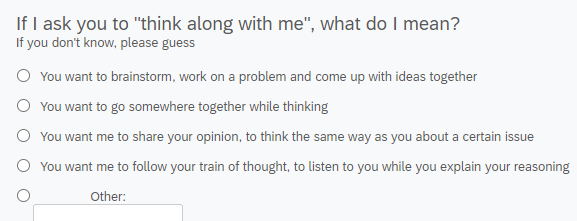
Here are the responses to that one:

When a Dutch person uses the phrase “please think along with me”, they are asking their conversation partner to brainstorm on a problem with them. These results suggest that that is not how they would be understood.
(The 5 people who replied “other” all said that they thought it was a combination of the two most popular answers. )
Some extra remarks people made
In my survey I gave people a chance to add remarks at the end if they had any. Here are some remarks people had about “to think along with”:
When I hear “think along with me”, it sounds like something an elementary school teacher (of ages 5-7) might say to their students, not something that adults would use with each other.
I would use “put our heads together,” a common phrase for that. Doing anything “along with” someone implies that they’re the expert and you’re keeping up, like “cooking along with” might mean watching a video while you try to make the same dish.
The “along with me” construction in English implies that the speaker is leading and the other person is being invited to follow; I would not expect a collaboration.
Conclusion: “to think along with” is not a good translation for “meedenken”
The term “meedenken” is used very often in Dutch to mean brainstorming a solution to a problem together. Many people translate this with “to think along with”, but when a Dutch person asks “Could you think along with me?” they are very likely to be misunderstood, as the majority of non-Dutch people over the age of 21 feel that this would mean that the Dutch person wants them to follow their train of thought, to listen to them while they explain their reasoning.
Is this a huge breakdown in communication? Probably not, the meanings are very similar, and when two people are talking together and one of them uses this phrase, it will probably sort itself out.
When a Dutch person is speaking, they would do well to say something like “Do you have a minute to brainstorm solutions for this problem I am having?” or “Can I pick your brain for a second?”
More importantly, when a translator (such as myself) is translating a Dutch text into English, “meedenken” should NOT be translated as “to think along with”.
So how SHOULD I translate “meedenken”?
I talk about that at length on my Dutch site hoezegjeinhetEngels.nl, where I try to find good translations for difficult-to-translate words. I’m not 100% happy with any of my translations for “meedenken”.
Ideas that I have come up with include “to bounce ideas off a person”, “to brainstorm solutions”, “to put your heads together”. You can read them all here.
Dutch companies love saying “we denken graag met u mee!” which I find especially tricky. Do you have any good ideas for a translation? Let me know in the comments!
Stuff I should have done better
A number of people disapproved of the fact that I asked people if something was “good English” or not. They felt I should have written something like “it is not natural-sounding English”. The reason I asked the question the way I did was because 1) I wanted to keep things simple and 2) I am interested in how Dutch people would be perceived if they were interacting with English speakers. I felt the perception of “is it good English” was more important than “is it natural English”. But it’s all open to debate 😉
There were 4 people who noted that I had written down the answer options incorrectly, and their answer would have been “I want you to follow my train of thought, to listen to me while I explain my reasoning”. They were, of course, completely correct – my answer options did not fit my question properly. Luckily it appears most people weren’t phased by my own bad English.
Choosing which responses to include
I got a whopping 1990 (!!) responses. (This is the power of Reddit. I highly recommend it to any university student trying to get responses for their thesis.)
To my regret, I had to take away 830 responses for this particular question, because I had made an important omission in my answer options, and the responses via Reddit were so fast that by the time I had noticed and rectified it, all those people had already started filling in the survey. (Lesson learned: always do a pilot survey with just a few participants, so you can pick up on omissions!)
Of those left, I had to remove 126 people who had not filled in the whole survey. I also took away everybody under the age of 21 (a whopping 375 people; see here the downside of doing research via Reddit), because I wanted the answers to reflect the kinds of people that might potentially do business with Dutch people. Then I took away everybody who spoke Dutch, German or Afrikaans (71 people), because I wanted to know what people thought who had never heard the term “meedenken” (or the very similar German “mitdenken”).