For Dutch speakers, there is a special kind of pleasure to be had when they can spot a Dutch artefact in the background of an American film or computer game. Whether the creators meant them as official “Easter Eggs”, or whether it was just a coincidence, here are a few times when some tiny bit of Dutchness crept into international media!
I have only been able to find four of these Easter Eggs so far, but I am sure there are many more. Have you ever noticed a bit of Dutchness (or Flemishness!) in the background of a movie, series, game, or other type of media? Let me know!!
(Note: Of course, some films and series have an explicit Dutch theme. The Fault in Our Stars, for example, is set partly in Amsterdam. In Friends, bartender Gunther was supposed to be Dutch. Ted Lasso features a romance with a Dutchman on a houseboat. This article is meant for the unmentioned, secret little nods to the Netherlands and Flanders.)
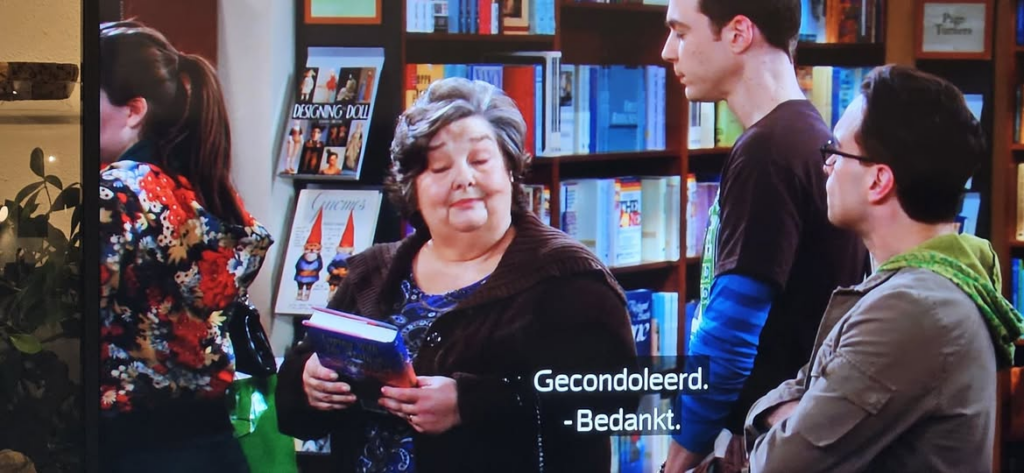
Rien Poortvliet in “The Big Bang Theory”
A scene in a book shop in the popular comedy series Big Bang Theory has the 1976 Dutch classic Gnomes (Leven en werken van de kabouter) in the background. This book, illustrated by Rien Poortvliet, was a huge international success when it came out. A nerd-book avant la lettre, the book illustrates the life and habitat of gnomes much like a serious biology book would. Anyone who knows the themes and humour of The Big Bang Theory will agree with me that the book’s placement is probably not a coincidence.
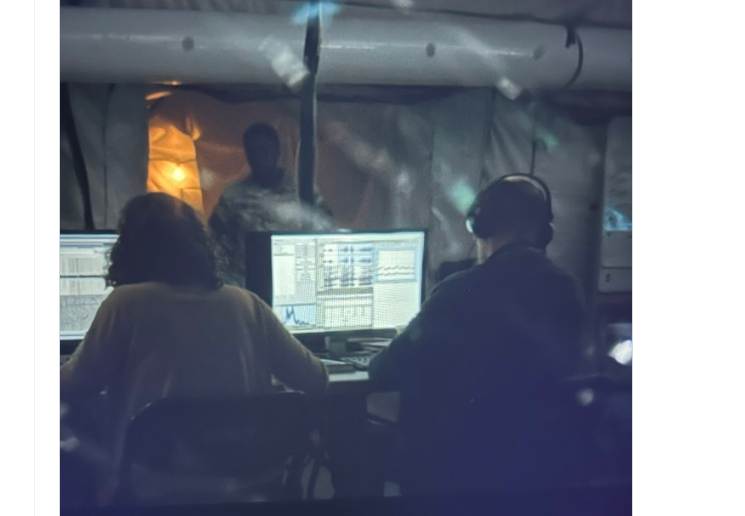
The major 2016 motion picture Arrival, about aliens coming to Earth and the linguists tasked with finding a way to communicate with them, was a joy to watch for professional linguists all over the world due to its many accurate elements about the daily work in the field of linguistics.
One such element is the fact that scientists in the background can be seen working with the software Praat, which is used for the analysis of speech sounds.
This open-source software was developed at the University of Amsterdam by two Dutch academics and has been going strong as the software of choice for linguists the world over since 1995.
Febo in Mass Effect
The popular 2007 video game Mass Effect, set far in the future, included images of a futuristic Febo; the Dutch fast-food restaurant where customers can famously put a coin in a slot to take a hamburger, kroket or bamischijf “out of the wall”.
Contributors on Reddit theorise that a Dutch developer must have added this Easter egg. Apparently later versions of the game no longer have it, because the image had not been cleared with Febo.
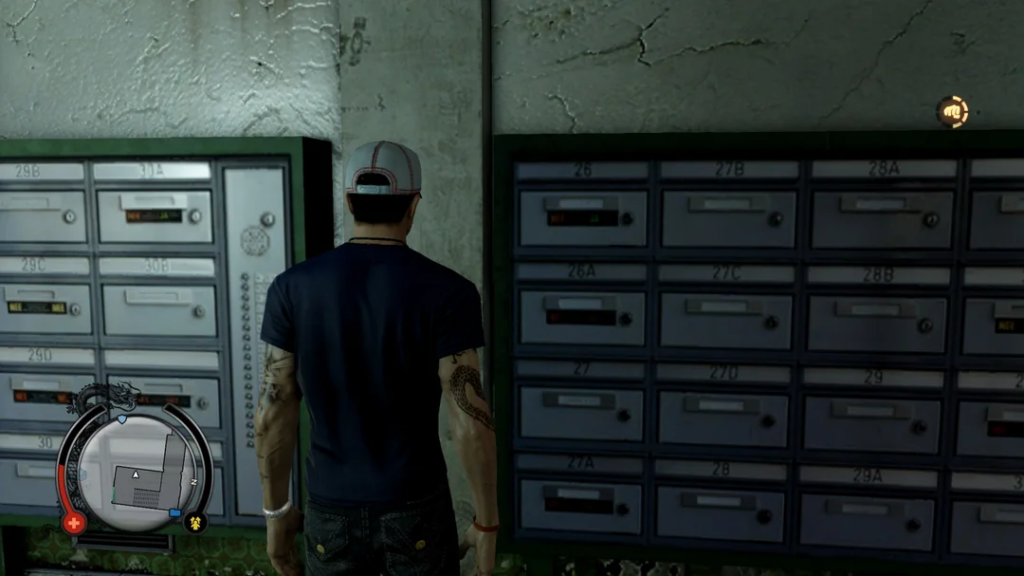
Dutch Nee/Ja stickers in Sleeping Dogs
It’s a little tricky to see in this picture, but the letterboxes in the scene above have Dutch stickers on them alerting deliverers to the fact that the owner of the letterbox does not want any unaddressed junk mail. These stickers are ubiquitous in the Netherlands and very recognisable.
A Redditor noticed this in the 2012 computer game Sleeping Dogs, and the consensus seems to be that there must have been some stock photos of Dutch scenes in the media packages that game designers use to build so-called “textures” (3D backgrounds in computer games).
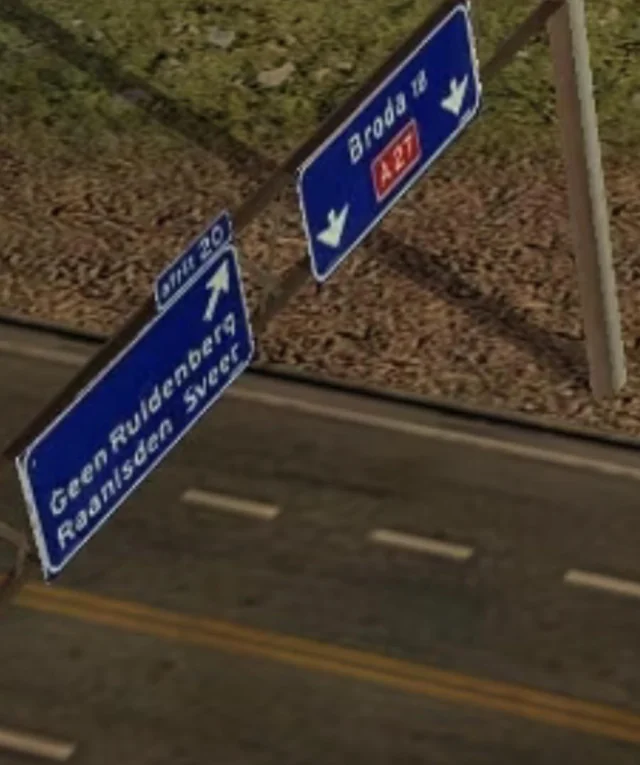
In the same thread, another Redditor noted that some of the roads in a game called C&C Generals looked like this:
These were all the Easter Eggs I was able to find so far. If you know of any more, let me know in the comments or on social media!
Click here to display content from englishandthedutch.substack.com.
Heddwen Newton teaches English and Dutch, and is also a translator and a linguist. Her newsletter English and the Dutch is about all the funny and interesting ways Dutch and English overlap.
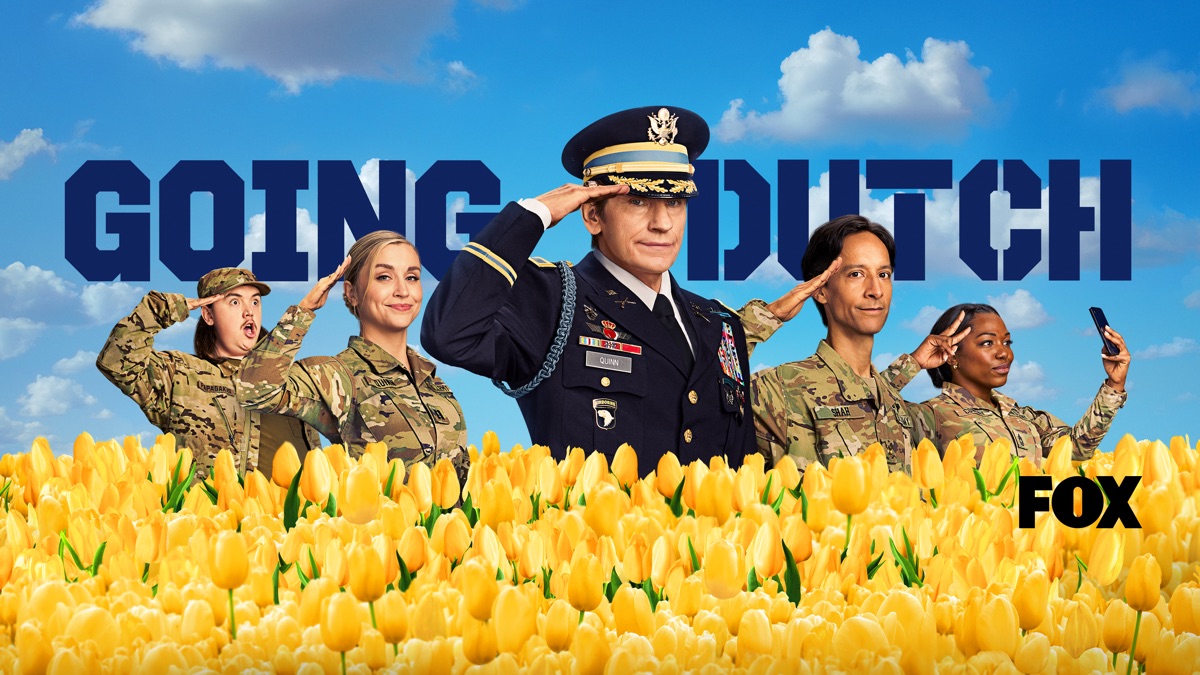
In January 2025, American broadcasting company Fox started airing a sitcom called “Going Dutch” about an American colonel who is reassigned to lead a small military base in the Netherlands as punishment. (Punishment for him, not for the Dutch. Though I guess it’s debatable.) The sitcom was renewed for a second season which aired from January 2026.
I write about all the ways the Dutch and the English language overlap and interact, and have a special interest in how Dutch-speaking culture is represented in English-speaking media. That meant that when I learned about the existence of this series, there was nothing for it: I had to sit myself down and watch the whole thing.
Did the writers just know nothing about Dutch culture?
Watching this series as a Dutch speaker, the cultural inaccuracies washed over me right from episode one. At first, I assumed there was a lack of knowledge and/or fact-checking on the part of the writers, but as I kept watching, I realised most inaccuracies had been chosen for comedic effect. Every now and then there would be a nod to Dutch culture that told me at least one of the writers knows more than a little about the Netherlands. They just didn’t have “culturally accurate” as their goal, here. The goal was to be funny.
All the things the series “Going Dutch” gets wrong about Dutch culture
8) A Dutch village wouldn’t be called Stroopsdorf
The American army base that is home to all the high jinks in this series is located in a fictional village called Stroopsdorf. “Dorf” is German, not Dutch. Had the writers chosen to call the village “Stroopsdorp” it would have actually been quite a good funny hypothetical Dutch village name. But that “f” at the end ruins the whole thing.
7) The Dutch accent doesn’t sound like that
Neither of the two Dutch main characters are played by Dutch actors, and the accents are appalling.
Arnmundur Ernst Björnsson plays Jan, a stereotypically flamboyant gay character (except it later turns out he has two female partners – polyamory apparently being a safer Dutch trope for Fox than homosexuality) who is on the base as a translator. Björnsson is an Icelandic actor who is putting on what sounds to me like a parody of a WWII-era German accent.
(He gets called Ziggy Stardutch in one episode which I did think was funny.)
Catherine Tate, the redhead from Doctor Who (not that one, the other one), plays Dr Katja Vanderhoff who owns (hahaha, so funny) the local brothel, and is the colonel’s love interest in season 1. I love Tate as an actress, but her accent goes from the Scandinavian chef from the Muppets to Irish and back again. Every now and then she hits on a sentence that actually sounds a little Dutch. But not often.
6) The game of korfbal does not feature a teenager playing a traditional Swiss (?) mountain horn to signal start and half-time.
No comment.
5) There couldn’t be possums in the air tower
One of the recurring jokes in the first season is that there are possums squatting in the air tower – except there couldn’t be, because possums do not live in Europe. Like, at all.
4) There aren’t that many tulips around
In the series, there are tulips everywhere. Giant tulip statues on the grounds. Tulips on the tables in every eatery. Tulip posters, tulip paintings. Granted, in touristy areas in the Netherlands you will see a lot of tulip imagery, but a random army base does not need to appeal to any tourist, and so apart from a few tulips in the flower beds in spring, you really wouldn’t see them in such abundance.
3) The Netherlands does not look like a cute Irish village
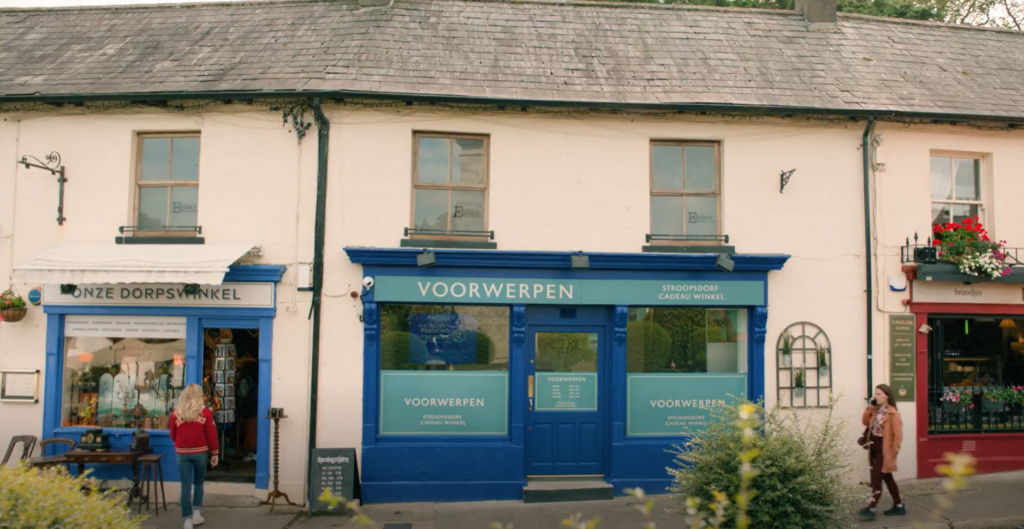
For unknown reasons (cough, tax breaks, cough) this show was recorded in Ireland. That means that when we get a look at “downtown Stroopsdorf” for the very first time in Episode 6 Season 2 it looks so much like a charming Irish village that you can almost hear the tin whistle music drifting through the streets.
2) There are no shops called “voorwerpen”
They changed some shop fronts to make them seem Dutch. I just love the gift shop called “voorwerpen”.
“Voorwerpen” means “objects” and though it could totally be the title of an avant-garde art show about everyday items, it is not a very marketable name for a shop.
1) And finally: no, we do not live in fear of Belgian separatists.
For the plot of episode 4 in season 2 to work, they needed a character who would be seen by the audience as a bad guy straight away and with little explanation. A terrorist.
So they went with… a Belgian seperatist.
In the episode, Belgian separatists are protesting in Stroopsdorf, which is in the Netherlands, in French, because they want to establish their own country. One of them has particularly nefarious intentions; he plans to plant a bomb! (Oh no!)
Where to start?! Belgium, of course, already is its own country. They did have to fight a war against the Dutch, to be fair, but this was 1830 to 1839 and is pretty much water under the bridge by now.
The French speakers in Belgium are Walloons, and though I am sure there are a few out there who would like Wallonia to be its own country, this is very much a fringe view, and there is definitely no terrorism involved.
Also, the hypothetical Walloon separatists in question would go and protest and be nefarious in Brussels, you know, what with that being the capital of Belgium, and not in a small random village in the Netherlands. It’s as if Colorado would go and fight for its independence in the Canadian town of Baie-Saint-Paul.
There were a few things it got right, too
7) Yes, there are a lot of bicycles everywhere
The series goes out of its way to make sure there are people cycling around in every outdoor scene, and bicycles parked on every street corner. This, I would say, is accurate.
6) Yes, korfbal is a thing
Korfbal is an existing Dutch game that is played mostly in the Netherlands and Belgium but also in the rest of the world. As the episode portrays, it is indeed co-ed, with men and women playing together, and it is quite close to being basketball but with round wicker circle-baskets instead of nets.
5) Yes, our KitKats are better
In Season 1 episode 5 a character says: “In the Netherlands the biggest threat to the United States is how much better their KitKat is.” This is true! It’s a different recipe, way more chocolaty!
4) Yes, we’re pretty direct
In season 1, episode 7, Katja, the main character’s Dutch girlfriend, tells his adult daughter she doesn’t like her, and explains exactly why. This is in keeping with a stereotype about the Dutch that has a good basis in truth: Dutch people are very direct and they say what they mean.
3) Yes, at Christmas, many families do put raw ingredients on the table and expect guests to cook it themselves in teeny little pans
For Katja’s Christmas party they do gourmetten, a tradition where an electric grill is placed on the table and you get little pans to fry your own food, which is provided raw. This really is a thing in the Netherlands, and I completely agree with the main character who thought it was quite stupid.
2) Yes, our labour laws are pretty protective of employees
In season 1, episode 8, the colonel finds out that it is very difficult to fire someone in the Netherlands, they need to have transgressed three times and even then you need to hire a mediator. I don’t think this is true for all companies, but I do believe it is true for civil servants.
And yes, Dutch people get unlimited sick days. (How could you not? If I have a high fever, I can’t come to work, no matter if it is my 5th or 50th sick day, no?)
1) A Dutch person gets played by a Dutch actor two whole times
In the whole of the two seasons, there are two Dutch bit parts that actually get played by Dutch actors. In episode 9 of season 1, Maud, a laundry assistant who attracts two romantic rivals, is played by Dutch/French actress Anaïs van der Werff, and in episode 10 of season 2 Jan’s uncle Dietrich is played by Dutch/Canadian actor Walter van Dyk. Each of them gets about three lines, but they are three correct lines. Hurrah!
Things that “Going Dutch” got right. Ish.
6) The first day of herring season is not a national holiday, but it is celebrated in Scheveningen
Vlaggetjesdag is celebrated in Scheveningen on 22 June, when the first fresh herrings come in. It is, alas, not a day when all of the Netherlands stops working, as suggested in Season 1, Episode 9.
5) There is no Dutch village that celebrates “second Christmas”, but at least the backstory is based in truth
Season 1 Episode 7 features a Dutch Christmas in spring, which the writers cleverly decided would be a local Stroopsdorf tradition, rather than a national one (which would have been pushing it). They even gave the tradition a backstory based on kinda, sorta reality.
The fictional explanation has it that Stroopsdorf couldn’t celebrate Christmas in 1944 because of the war, so they decided to celebrate Christmas after they were liberated in spring, and then the tradition of having a second Christmas lived on.
Though there are no places in the Netherlands where this is an actual tradition, it is at least true that most families were indeed forced to skip Christmas during the last war winter in the Netherlands. “Skip” sounds a bit too innocent, though; it was known as the Hunger Winter and many people died of starvation.
The Netherlands was then liberated on 5 May 1945, which is indeed spring, though of course people would have had other things on their minds than celebrating Christmas. Also, though the allied troops brought food, I don’t think a Christmas banquet was on the cards immediately after Hitler popped his clogs.
In this Christmas episode, our main Dutch character Jan, still played with an excruciating accent by an Icelandic actor, dresses up like Sinterklaas, whose costume they get right. He explains that Sinterklaas puts candy in little children’s boots (yes, correct) and travels from Madrid in a boat, which, other than Sinterklaas, is only carrying oranges… Well, two out of three, I suppose.
4) During WWII, Dutch children did run errands for food. I don’t think they laid mines, though.
It’s a throw-away joke, but in season 2 episode 10 Jan’s uncle Dietrich admits to having placed mines for German soldiers in return for chocolate. (It’s funny because it makes him a nazi, haha). Though chocolate was nowhere to be found during the war (the allied soldiers famously gave kids chocolate after the liberation), and laying mines seems very extreme, children probably did run errands for the Germans in return for food. Because, you know, they were hungry.
3) The printed Dutch is at least tolerable
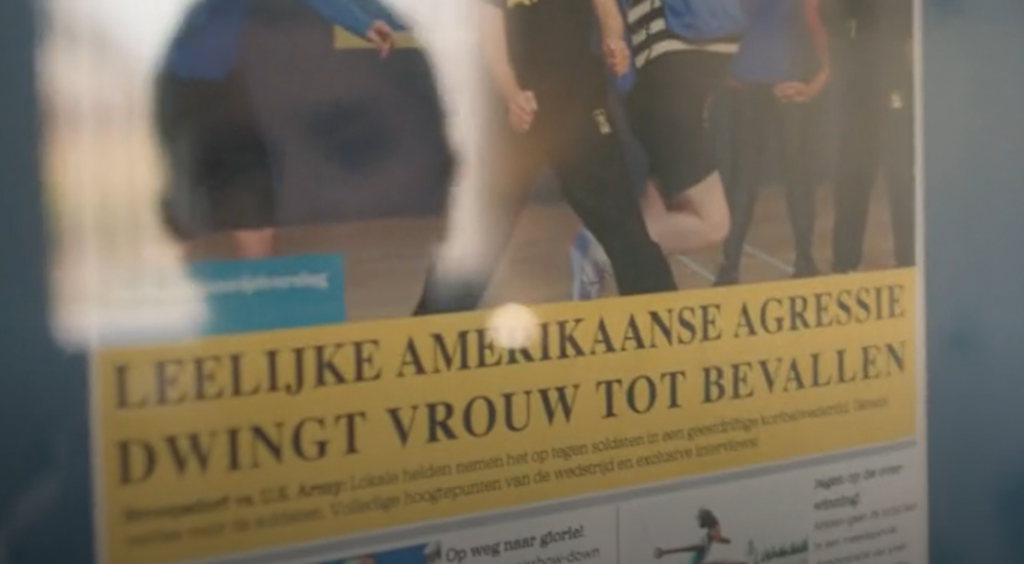
Every now and then an episode will feature a poster or a pamphlet or something in Dutch. The translations are very literal and have clearly been generated by a machine. Sometimes there seems to be an extra vowel, which I think is probably intentional, because those double vowels make our language look extra foreign to English speakers. But at least is isn’t just gibberish, we have to give them that.
an extra e in “leelijke”, on purpose perhaps, to make it look more Dutch?
2) Catherine Tate does a passable job speaking Dutch
In Season 2, episode 2 we hear a few Dutch sentences for the first time; before that it was just the odd Dutch word. Catherine Tate seems to have actually done some homework and does an okay job. Yay!
1) Niksen is a thing, but you don’t get together to do it, because then it wouldn’t be niksen
Season 1, episode 8 starts with Dutch civilians lazing about on the army base’s grounds, cycling, playing hacky-sack, doing yoga. “It is the Dutch art form of niksen, the art of doing nothing” a character explains.
Niksen is a thing, though one of those things that is more a thing when explaining it to foreigners than that it is actually a thing.
The extras in the episode were doing it wrong, though – doing yoga and cycling is definitely not “niksen“, because they are not doing nothing, they are cycling and doing yoga. Duh.
Heddwen Newton teaches English and Dutch, and is also a translator and a linguist. Her newsletter English and the Dutch is about all the funny and interesting ways Dutch and English overlap.
As someone who writes professionally about the Dutch language in English, I’m pretty versed in Dutch proverbs. So when I see someone quoting a “Dutch proverb” that isn’t actually a Dutch proverb, I’m always curious: how and why did this come about?
This time, my journey started at Vogue.com, where journalist Emma Specter gleefully announces that there’s a biopic coming out about American TV personality Martha Stewart starring Cate Blanchett. She mentions:
“I can only pray that it will share at least some DNA with Martha, R.J. Cutler’s 2024 documentary …in which Stewart… hits us with this iconic Dutch proverb: “If you want to be happy for a day, get drunk. If you want to be happy for a year, get married. But if you want to be happy forever, plant a garden.”
Specter probably got it from her colleague Lilah Ramzi, who quotes the same version of this proverb in Vogue in October 2024.
Did Martha Stewart really say this?
Yes, though she says it slightly differently:
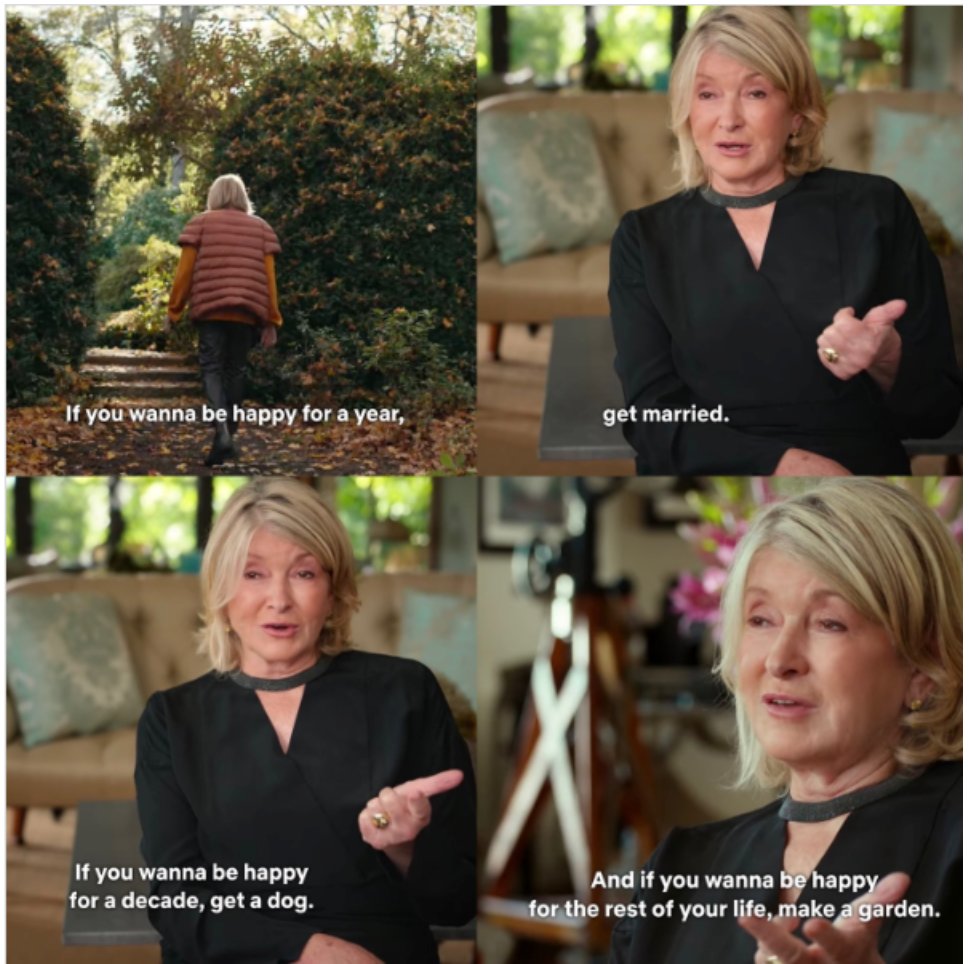
“If you want to be happy for a year, get married. If you want to be happy for a decade, get a dog. If you want to be happy for the rest of your life, make a garden.“
(I prefer this version, if I’m honest. Dogs are funnier than alcohol!)
I found this article that links to the clip on TikTok and provides this helpful meme from the documentary.
Importantly, the clip makes clear that it was not Martha Stewart herself who named it as Dutch, but Vogue. In the clip, Stewart just says “there’s a little saying that I like”.
Would Stewart have used a Dutch proverb?
According to Wikipedia, Martha Stewart is of Polish descent, not Dutch, and I see no links to the Netherlands or Flanders of any other kind in her biography. No Dutch husbands or anything like that. So she would not have had a stock of Dutch proverbs from e.g. her grandparents to trot out.
Did Vogue just invent that it was Dutch, then?
No, I think they must have found a source on the internet saying it was Dutch. I found this quote on GoodReads from 2016, for example:
“The Dutch have a proverb for it: “If you want to be happy for a day, get drunk. If you want to be happy for a year, get married. But if you want to be happy for a lifetime, plant a garden.”
(GoodReads, you should date your posts!! I’m assuming this post was from 2016, because that is when it got its first like.)
According to the American Rhododendron Society (which understandably might like quoting proverbs about gardening every now and then) the proverb is Chinese, and actually goes like this:
If you want to be happy for an hour, get drunk. If you want to be happy for a day, get married. If you want to be happy for a week, kill your pig and eat it. If you want to be happy all your life, BE A GARDENER!
But there are all kinds of versions on the internet, for example, this one from 2018 on Facebook (which makes more sense than the Rhododendron Society one)
If you would be happy for a day, get drunk. If you would be happy for a week, roast a pig. If you would be happy for a year, get married. If you would be happy for a lifetime, plant a garden.
What they have in common is that they all tend to note that it is a Chinese proverb.
The only exception to this rule is on a few quotation websites with a quote that they attribute to British comedian Arthur Smith:
If you want to be happy for a short time, get drunk; happy for a long time, fall in love; happy forever, take up gardening.
Conclusion (for now): it’s probably Chinese
As I know for certain that it isn’t Dutch, and I feel like Arthur Smith was probably quoting an existing proverb just like Martha Stewart was, I think the Chinese proverb origin theory sounds the most likely.
However, I have not been able to find any reputable sources with conclusive evidence, nor have I been able to find the original version of the proverb. Was the pig in the original, for example, or is that just a fanciful addition? If someone with knowledge of Chinese is reading this, please let me know in the comments!
Heddwen Newton teaches English and Dutch, and is also a translator and a linguist. Her newsletter English and the Dutch is about all the funny and interesting ways Dutch and English overlap.
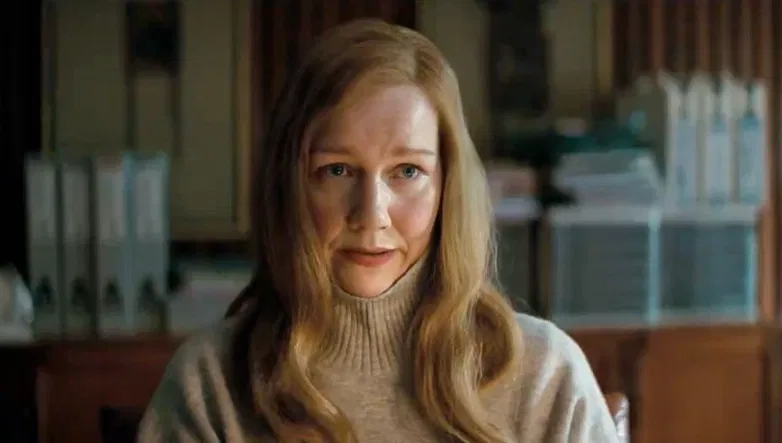
Okay, it doesn’t matter to the plot very much, but Dutch speakers don’t often get a character that represents them, so it is a shame that the Dutch character of Eva Stratt (European Space Agency administrator and boss lady) was changed into a German for the movie Project Hail Mary.
(We can know for sure that she is German in the movie, because she mentions it when she is talking about singing in a choir in her youth. In the book she is clearly referred to as being Dutch.)
To be fair, “Stratt” was always more of a German name, and it seems perhaps author Andy Weir made a research mistake when he named her. (Though there are plenty of Dutch people with German names, like author Herman Koch and historian Philip Dröge. So perhaps she was one of those.)
Another “to be fair”: actor Sandra Hüller did a phenomenal job and seemed just right for the part, bringing humanity in just the right dosage. Well done her.
But since I write a newsletter about (among other things) how Dutch speakers are represented in English-speaking media, this is worth a mention to me. In the book, Eva Stratt is Dutch. In the movie, she is German. Now you know.
Heddwen Newton teaches English and Dutch, and is also a translator and a linguist. Her newsletter English and the Dutch is about all the funny and interesting ways Dutch and English overlap.
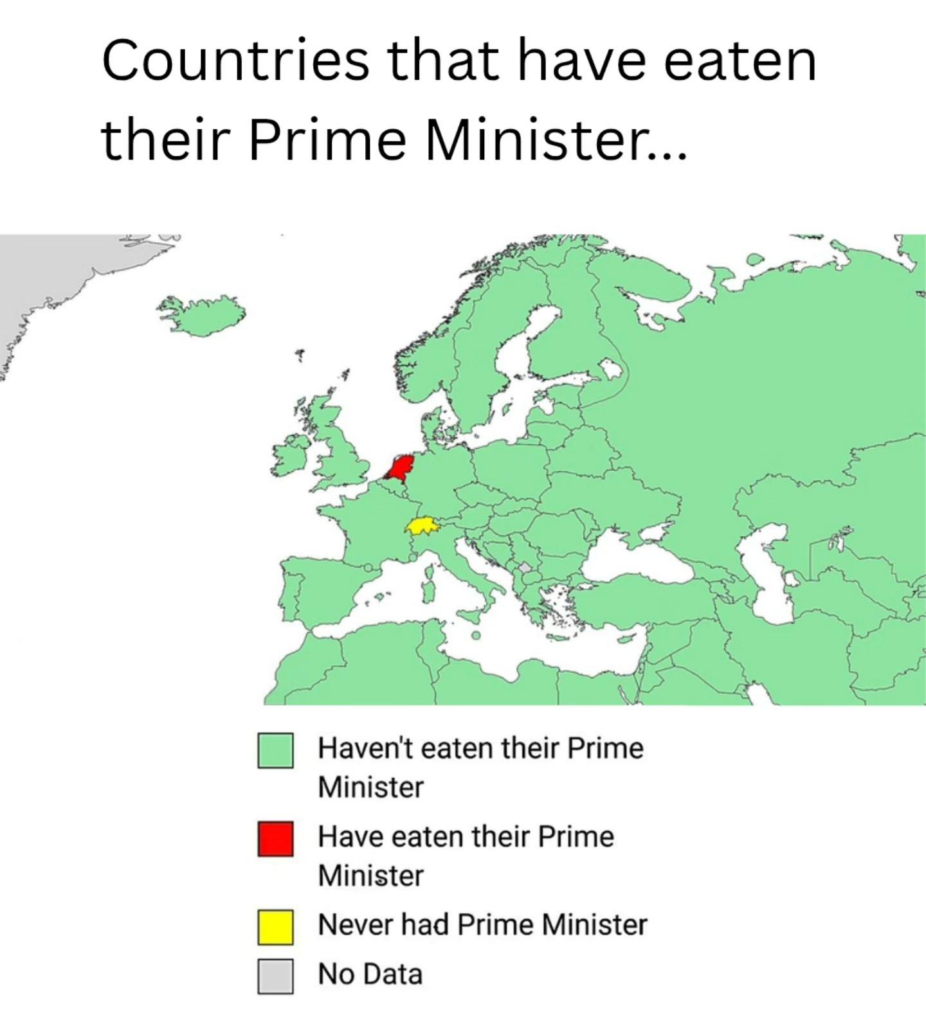
From the super-reliable sounding Facebook group “History Cool Kids”
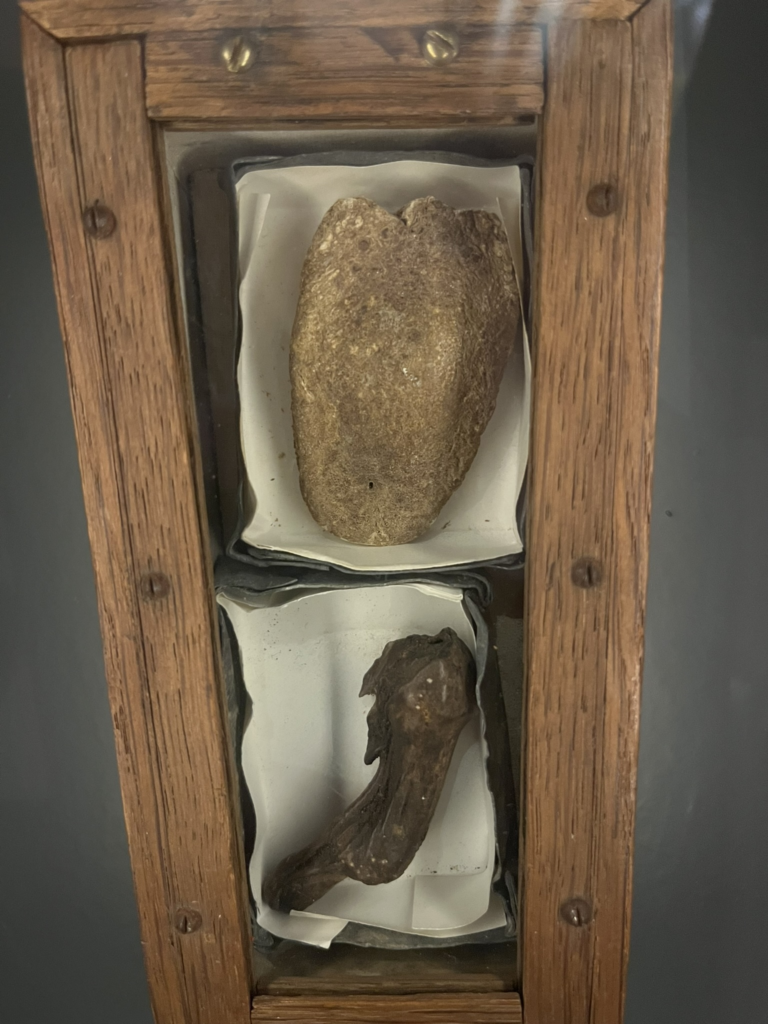
In 1672, during a major crisis in the Netherlands, a mob captured and executed the former leading statesman Johan de Witt (who was effectively serving as prime minister). He was then partially eaten by the mob.
Under his leadership, though not because of his personal failures, the Dutch Republic was attacked simultaneously by England, France, and the German states of Prince-Bishopric of Münster and Electorate of Cologne during the Franco Dutch War. Although the Dutch ultimately survived the invasion, the year became known as the Disaster Year because of the scale of military and political collapse.
The violence was also tied to internal political rivalry, and some contemporaries and later historians have suspected the influence of William III of England, then Prince of Orange, who benefited politically from the crisis and rose to power as stadtholder before later invading England in 1688 and becoming king.
The aftermath was famously depicted in a painting by Jan de Baen, and many Dutch historians still regard Johan de Witt as one of the greatest statesmen in the country’s history, which makes the episode especially tragic.
And you can apparently see his tongue and finger in The Hague:
I wasn’t quite ready to start publishing on this website, but then I saw John Oliver’s Last Week Tonight episode on carbon offsets, and I thought: “well, there’s my first post.”
In the episode, Oliver ponders the term “ten dollars to offset your pig”. An then comes this bit:
“Ten dollars to offset your pig” sounds like a Dutch sex act that was sent back and forth through Google Translate one too many times.
He then puts on a strong, fake Dutch accent to impersonate what I assume is meant to be a Dutch pimp, and says:
“For ten dollars, Basilius, he offset your pig. So good, so strong, your eyes will pop, and your brave testicles will switch (twitch?). So are we doing this? Basilius! Offset that pig!”
Okay, first off, John Oliver is amazing, and I’d totally marry him if I weren’t happy with my partner, and he weren’t happily married, and we would meet somehow on an airplane or something, and he’d be romantically interested in me, for the long term, not just a fling. By making serious issues funny, he is educating the world and probably having more positive effects on it than 1000 policy makers.
That having been said, let’s talk about the Dutchness:
Where he got the Dutchness right
Saying “he offset your pig” instead of “he will offset your pig” – this is an absolutely correct example of grammar from Dutch English speakers. When I’m proofreading English texts written by Dutch people, I sometimes feel adding “will” to future actions is, like, 80% of what I do.
Put in present tense, there should of course have been an “s” after “offset”; “he offsets your pig”. Most Dutch people wouldn’t do this wrong anymore, because it is drilled into them so thoroughly at school, but it is certainly a mistake that is made.
Saying “dis” instead of “this” – yep, that’s what they do. It’s something I plan to write about more in future, but I actually think using a “d” sound for the voiced “th” (like in “this”, “that” and “though”) is quite a charming part of the Dutch accent.
Saying “so strong” – Dutch people overuse the word “strong”, not because its literal translation “sterk” is such a much-used word in Dutch, but because they don’t know how to translate words like “krachtig”, “heftig”, “hevig”, “flink”, “fors”. They know “strong” isn’t the right word, but it’s the best one they can find in their mental English lexicon, and they know the listener will interpret it the right way, so they use it.
Where he got the Dutchness – kinda right?
Pronouncing “s” like “sh” – Okay, so this is a little bit true, but far too overdone.
The Dutch “s” is more forceful than the English one – the Dutch keep their tongue flatter than the English when making an “s”, meaning the air is pressed past more of the tongue. To Dutch people, this doesn’t sound like a “sh” at all, but to English people, who make the “s” with the tip of their tongue only, anything that uses more tongue than that sounds like a “sh”. When they copy a Dutch accent, that is often the feature that they choose.
It is my personal observation that Dutch people of a younger generation are far better at pronouncing the “s” in a more native English way, and it is the older Dutch that have that “sh”- way of speaking. And even for that older generation, I don’t think it is a fair portrayal of their accent to make the “sh” as pronounced as Oliver is doing. But he’s doing it for laughs, he needs a quick and dirty way to make it clear he is pretending to be Dutch, and the sh-thing is, for English speakers, a quick marker for the Dutch. So I get it.
This video from a Dutch comedian with a knack for accents goes over five ways to “do a Dutch accent” and you will notice the “s”- “sh” thing is not one of them. It just goes to prove my point that this marker is something from the past.
Something that sounds like a weird sex act gets connected to the Dutch – Oh well. I prefer this prejudice to anything to do with weed and drugs. Being open-minded about sex and allowing people to communicate freely about this topic means this little country has reduced a lot of problems that other countries still face.
Where he got the Dutchness wrong
Calling the prostitute “Basilius” – I have NO IDEA where this comes from, and if anyone reading this knows, please leave a comment! I can only think it’s a contraction of “Basil” (not a Dutch name in the slightest) and “Cornelius” (a very outdated Dutch name). I guess they wanted a Dutch-sounding name with two “s”-es so they could use it for the “sh”-joke, and “Basilius” sounds Dutch to Americans???
“Your brave testicles” – Dutch people do misuse the word “brave”, thinking it means “obedient”, but they would not use it in this sentence.
“Dollars” – obviously, if you travel to the red-light district in Amsterdam hoping to offset your pig, you will be paying in Euros, not dollars.
Heddwen Newton teaches English and Dutch, and is also a translator and a linguist. Her newsletter English and the Dutch is about all the funny and interesting ways Dutch and English overlap.