I write about language, and I like being on Threads. It’s text-based social media with an algorithm that does a pretty good job at showing me stuff I am interested in.
Recently, somebody appeared on my feed asking “why isn’t a strawberry called an earth-berry, like it is in Dutch?”
Why is it “strawberry”, and not “earth-berry”?
Great question. I did some quick research and found out that English is indeed an anomaly here; almost all Germanic languages call the sweet red fruit an earth-berry.
So why strawberry? My research suggested there were several possible explanations, but that the one currently favoured by many etymologists is one set out by medieval western languages expert William Sayers.
His explanation also happens to be quite satisfying for Dutch speakers, and as etymologies that are quite satisfying for Dutch speakers are my bread and butter, I was happy to post my answer, (which I will paraphrase here as I wrote it in Dutch):
The “straw” in “strawberry” probably refers to the verb “to be strewn”. The plant likes to propagate itself around; for Dutch speakers: to strooi (=spread) itself around.
(For English speakers: strooi sounds an awful lot like “straw”, which is what makes it so satisfying.)
Note that I used the word “probably”. Of course I did. We don’t have a time machine to go back, and so we can never know for certain where any word comes from.
A lady tells me that I am wrong
A lady responded to tell me I was wrong and that the “straw” in “strawberries” comes from the fact that straw is used to prevent the berries from touching the ground and rotting.
I asked her for her source, and she came back with … Gardeners’ World.
Ah, yes, of course, Gardeners’ World. Known to be such a dependable source for linguistics and etymology.
I explained my answer in a little more detail, adding that the “strewn” theory was the most likely theory according to many etymologists, but that there are other theories. For example, that the little seeds look a bit like straw, that the plant likes to grow in hay-fields, or simply that the plant itself looks a bit straw-like with those long stalks with the berries at the end.
Strawberries come from North America?
She answered, “This all sounds very unlikely if you ask me. Strawberries come from North America. Plus the word “strewn” has nothing to do with strawberries.”
I ignored the second part of her argument, which is akin to saying “the sky is purple because I say so,” but was completely baffled by the first part. Strawberries come from North America???
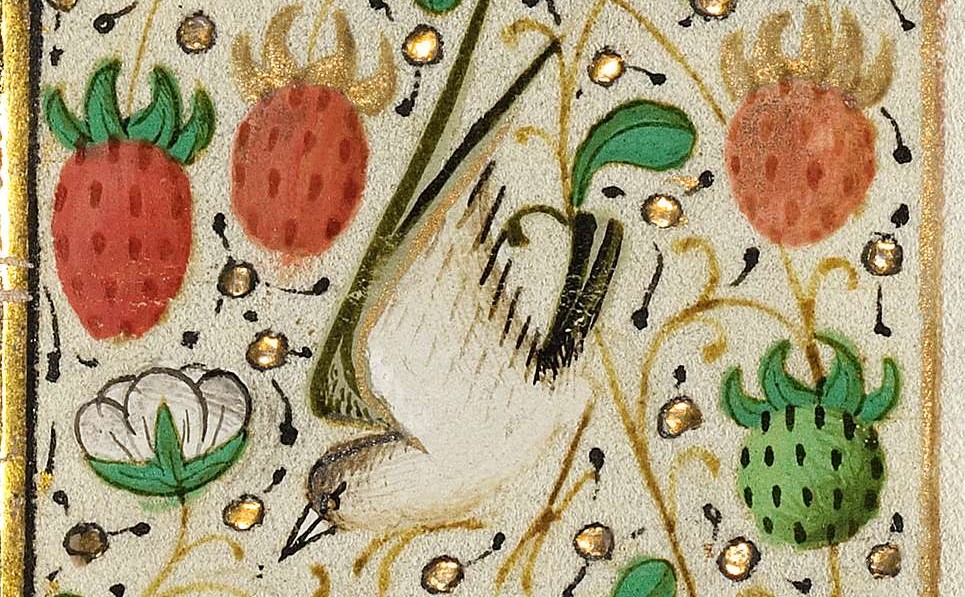
You have to understand, by this time I knew enough about the word “strawberry” to know it was really old. The Oxford English Dictionary notes the oldest instance of the word “strawberry” that we have in writing is from 1328. The image above is from the 1460s.
When did Europeans discover America again? Oh yes. “In 1492, Columbus sailed the ocean blue.”
I was utterly confused and once again asked for her source, to which she said, “wiki”.
I duly looked it up and found out that she was right, kinda. The modern strawberry, the fat juicy red fruit that we know and love today, is a mix of a plant from North America and another from Chile that was cultivated in France in the 1750s.
Why the “straw” in “strawberry” does not refer to the straw you put underneath while it grows
Our word “strawberry” originally didn’t refer to the modern garden strawberry plant at all, which has only existed since the 1750s. Instead, it refers to the woodland strawberry, a plant with much smaller fruits which grow higher up. A plant which does not need a straw bedding to prevent its fruit from rotting.
I cannot tell you how nice it feels to be proven right by an argument that was intended to prove you wrong. So thank you to that lady on Threads 🙂
Epilogue
By now, I have spent a lot of time on the internet looking at the etymology of strawberry, and I have seen that the “bedding of straw” theory has a lot of fierce proponents, especially on social media.
And I totally get it. If you grow strawberries yourself, or have been strawberry picking, you will have seen all this straw spread out underneath the plants and you will have thought “oh, that’s why they are called strawberries!”. It is an aha-moment that is hard to dislodge, especially, I can imagine, if you work for Gardeners’ World.
Second epilogue
When I downloaded William Sayers’ 2009 article I found that it made my whole journey above superfluous, as he explains the whole old strawberry vs new straberry thing right at the beginning. Read your sources, Heddwen!
Stuff I learned after writing this article:
Strawberries in Swedish are “earth-geezers”
The first version of this article noted that another exception to the “earth-berry” trend was Swedish, which uses the word smultron, which is of unknown origin. However, I have now learned that smultron is the name for the woodland strawberry, and the Swedish word for the strawberries you buy in the supermarket is jordgubbar, which means something like “earth-lump”, though apparently the gubbar part has lost its “lump” meaning and now means “old man” in a kind of slangy way, like “geezer” in British English. In other words, the Swedes have their whole own strawberry-linguistics thing going on, and I’m just not going to comment!
There’s a tradition in Norway that might also be relevant
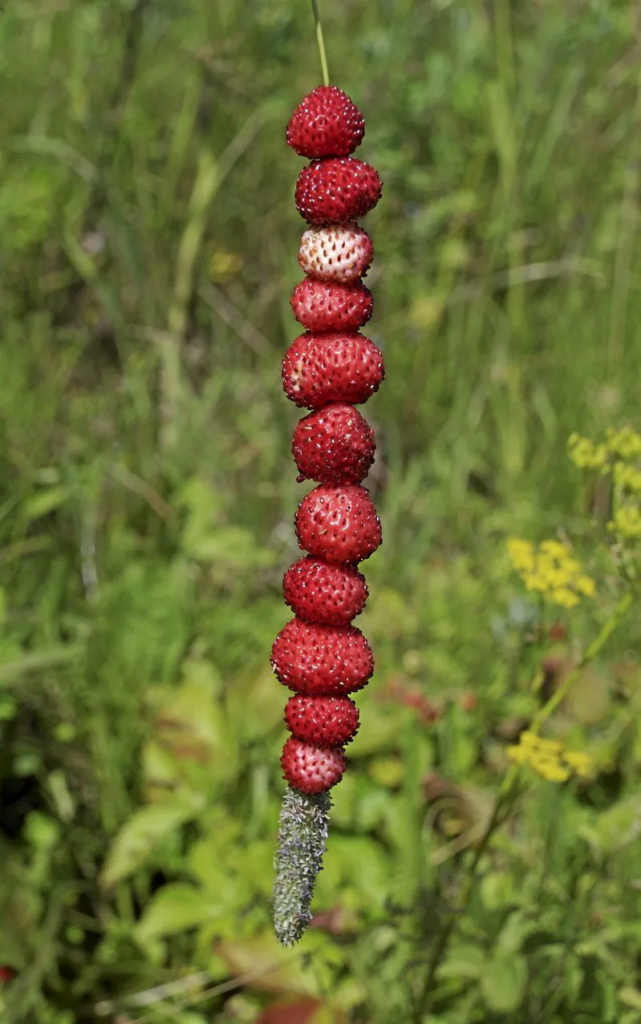
A Norwegian person commented on Bluesky that there’s a long-standing tradition in Norway to collect woodland strawberries by “threading” them on a length of straw as a way of keeping them to eat later on. I’m sure it’s a really old tradition, but is it so old that the Vikings brought it to England? I think probably not, but if there’s a historian out there who knows, please tell me!
Heddwen Newton teaches English and Dutch, and is also a translator and a linguist. Her newsletter
English and the Dutch is about all the funny and interesting ways Dutch and English overlap.